Ford 4000
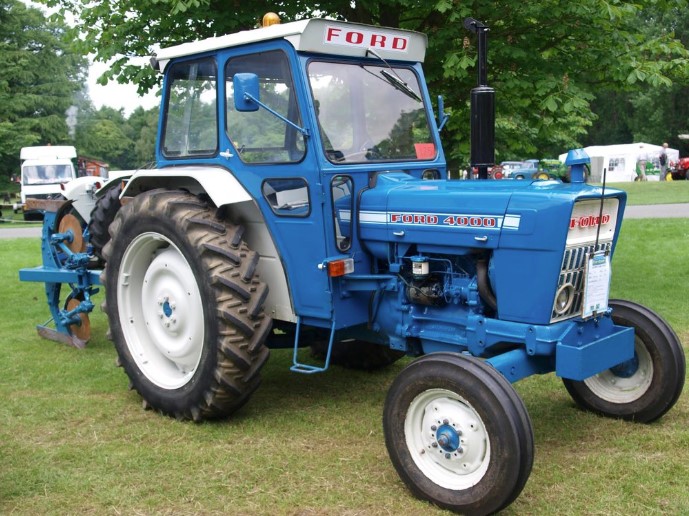
The Ford 4000 is one of the most iconic tractors in agricultural history, known for its transition from the "Red Tiger" era to the modern "Thousand Series." It was produced between 1962 and 1975 and is widely regarded as a versatile, medium-duty workhorse.
When discussing the Ford 4000, it is essential to distinguish between the two distinct versions, as they are completely different machines.
1. The Early Series (1962–1964)
The first Ford 4000 was essentially an updated version of the older Ford 801 series. It featured a 4-cylinder engine and was the last of the "old style" Ford tractors before the major redesign in 1965.
-
Engine: 2.8L 4-cylinder (Gas, Diesel, or LP Gas).
-
Design: Shared the same chassis as the 801/901 series.
-
Aesthetics: Often found in the classic blue and light gray/white paint scheme.
-
Key Feature: Known for being nimble and having a high power-to-weight ratio for its size.
2. The Late Series (1965–1975)
In 1965, Ford completely redesigned the 4000. This is the version most enthusiasts refer to today. It was built in Highland Park (USA), Basildon (UK), and Antwerp (Belgium).
-
Engine: 3.1L or 3.3L 3-cylinder engine. This engine was a "square" design (bore and stroke are the same), providing excellent torque and longevity.
-
Horsepower: Approximately 52–55 HP at the PTO.
-
Transmission Options: * 8-speed Dual Range: A manual "twin-stick" setup.
-
10-speed Select-O-Speed: A power-shift transmission that allowed shifting on the go without a clutch (though it requires careful maintenance).
-
-
Brakes: Improved with wet disc brakes inside the rear axle housing, which were much more effective than the dry drums on earlier models.
Key Specifications (3-Cylinder Model)
Common Variants
-
4100 (General Purpose): The standard utility version.
-
4200 (Row-Crop): Featured a higher ground clearance and adjustable front axle for working between crop rows.
-
4000SU (Special Utility): A "hybrid" that used the powerful 4000 engine and transmission but the smaller, shorter front end of a Ford 3000. It was popular for its maneuverability in tight spaces.
Why It’s Still Popular Today
The Ford 4000 remains a favorite for hobby farmers and collectors because parts are widely available and the mechanics are straightforward. Its robust 3-cylinder engine is famous for reaching 8,000+ hours if well-maintained, and it is large enough to run modern implements like 6-foot bush hogs or small balers.
Note: If you are looking at buying one, check the sheet metal. Pre-1968 models have louvers on the side of the hood; models from 1968–1975 (often called "Force" models) have smooth hoods and a different grill style.
To decode your Ford 4000, we first need to find the three lines of stamped numbers.
Where to Look
On almost all Ford 4000 tractors, these numbers are located on the right-hand side (as you are sitting in the seat). Look at the flat, horizontal shelf of the transmission housing, just behind the starter motor and above the lug nuts.
-
Tip: This area is often covered in decades of grease and paint. You will likely need a wire brush and a flashlight to see them.
-
Alternative: If you have a later model (post-1967), there might be a silver foil sticker on the underside of the right-hand hood panel with these same codes.
What the 3 Lines Mean
Once you find the numbers, they usually look something like this:
-
D1013C (Model Number)
-
9G12B (Production/Unit Code — This tells you the date)
-
C245600 (Serial Number)
1. How to Decode the Date (The Middle Line)
The "Unit Code" tells you exactly when it left the factory:
-
First Digit (Year):
5=1965,6=1966 ...0=1970,1=1971, etc. -
Second Digit (Month):
A=Jan,B=Feb,C=Mar,D=Apr,E=May,F=Jun,G=Jul,H=Aug,J=Sep,K=Oct,L=Nov,M=Dec. -
Third & Fourth Digits: The day of the month.
-
Last Letter (Shift):
A=Midnight,B=Day,C=Afternoon.
Example: 9G12B means the tractor was built on July 12, 1969, during the day shift.
2. How to Decode the Model (The Top Line)
The first letter identifies the series. For a 4000:
-
D (or a 4 on early models) = Ford 4000
-
10 = Agricultural All-Purpose
-
1 = Diesel / 2 = Gas
-
C = 8-Speed Transmission / E = Select-O-Speed
3. Where it was built (The Bottom Line)
-
C = Manufactured in the USA (Highland Park, MI)
-
B = Manufactured in England (Basildon)
-
A = Manufactured in Belgium (Antwerp)
While the Ford 4000 is legendary for its toughness, it has a few specific "personality traits" and common failure points that owners frequently encounter.
The issues vary significantly depending on whether you have the early 4-cylinder or the later 3-cylinder model.
1. Transmission: The "Select-O-Speed" (SOS) Trap
If your tractor has the 10-speed transmission (no clutch pedal, just a shifter with 1-10 and R1/R2), it is a Select-O-Speed.
-
The Problem: These were revolutionary but complex. Common issues include "surging" between gears, certain gears (like 5th and 7th) disappearing entirely, or the tractor refusing to move until the oil is warm.
-
The Cause: Most SOS problems stem from misadjusted bands or neglected oil filters. They require very specific "Type M2C41-A" fluid (or modern equivalent Ford 134D).
-
The Risk: Parts for these are becoming rare and expensive. Most mechanics today won't touch them.
2. Hydraulics: The "Hiccups"
A very common Ford 4000 issue is the 3-point hitch "hiccuping" (the arms lift, then drop slightly, then jerk back up).
-
Unloader Valve: In the late 3-cylinder models, the unloader valve inside the lift cover often gets stuck or the O-ring fails. If the lift won't work at all, it's often a stuck unloader.
-
Lift Cylinder Seals: If the hitch slowly drifts down when the engine is off, the piston seals in the lift cylinder are likely worn out.
-
Flow Control: The knob on the right side of the hydraulic pump often seizes up from lack of use, preventing you from adjusting how fast the hitch moves.
3. Power Steering Leaks
The power steering on the 4000 is a "boosted" system with a cylinder on the side of the tractor.
-
The Leaks: The most common failure is the seal on the steering column or the cylinder rod. It starts as a drip and eventually empties the reservoir (which sits on top of the pump).
-
The Pump: If it’s hard to turn, first check the internal filter inside the power steering pump reservoir. Many owners don't realize there is a filter in there that needs cleaning or replacement.
4. Fuel & Starting Issues (Diesel Models)
-
Bleeding Air: The 3-cylinder diesel is notorious for being hard to restart if it runs out of fuel. You have to bleed the filters, then the injection pump, and finally crack the lines at the injectors themselves.
-
CAV Injection Pump: The "distributor-type" pumps are reliable but can "gum up" if the tractor sits for years with old fuel, leading to a "no-start" condition.
-
Thermostart: If it won't start in the cold, the intake manifold heater (Thermostart) is often burnt out. It’s a cheap and easy fix.
5. Electrical: The Charging System
-
Generators vs. Alternators: Original models used Lucas or Autolite generators with external regulators. These are frequently "dead" on older tractors.
-
12V Conversion: Many owners convert them to a Delco 10SI alternator. If you do this, you often lose your tachometer (RPM gauge) because the original tach was driven off the back of the generator. You can buy special "tach-drive" alternators to fix this.
6. Rear Axle/Brakes
-
Wet Brakes: The late-model 4000 has brakes inside the axle submerged in oil. If someone used regular gear oil instead of Universal Tractor Transmission Fluid (UTTF), the brakes will chatter, squeak, and eventually fail.
-
Trumpet Leaks: The seals where the rear axles (trumpets) bolt to the center housing can develop leaks, especially if the tractor has done heavy loader work.
Market prices for the Ford 4000 vary significantly based on the year (early 4-cylinder vs. later 3-cylinder) and condition. Generally, these tractors have held their value well because they are small enough for hobby farms but powerful enough for real work.
As of early 2026, here is the current price breakdown:
Price by Condition
| Condition | Estimated Price Range | Description |
| Project / Non-Runner | £1,500 – £2,500 | Missing parts, seized engine, or severe leaks. Often bought for parts or major restoration. |
| "Work Clothes" (Original) | £3,500 – £5,500 | Faded paint, some minor leaks, but starts and works. Usually has high hours (5,000+). |
| Good / Refurbished | £6,000 – £9,000 | New tires, fresh paint, tight hydraulics, and power steering. Ready for daily use. |
| Show Quality / Restored | £10,000 – £14,000+ | Professional engine rebuilds, pristine paint, and all original gauges working. |
Factors That Add or Subtract Value
-
Transmission (+/- £1,000): The 8-speed manual (twin stick) is the most desirable and fetches the highest price. The Select-O-Speed (10-speed power shift) often sells for less because it is harder to repair.
-
Engine Type: Diesels typically command a £500 – £1,000 premium over gasoline models due to better fuel economy and longevity.
-
Power Steering (+£500 - £800): If it has a working factory power steering system, it’s worth more, as these tractors can be very heavy to steer with a front-end loader.
-
Front End Loader (+£1,500 - £3,000): A Ford 4000 with a working, braced loader (like a Ford 771 or a Bush Hog brand) is highly sought after for small acreage owners.
-
The "SU" Model (Special Utility): These rare hybrids (4000 power with 3000-series front axle) often fetch £1,000+ more because they are shorter and more maneuverable.
Regional Differences
-
USA: Prices are strongest in the Midwest and South where they are still used for haying. Expect to pay £4,500 to £7,000 for a solid runner.
-
UK/Europe: There is a massive collector market here. A "Force" series (post-1968) Ford 4000 in good condition can easily exceed £7,000 – £8,500 at auction.
We have a number of manuals that can help with restoration, service, operation and repair of the Ford 4000 Tractor.